
Hair shedding is one of the most common worries people raise after starting a GLP-1 medication. Short answer: it can happen, it is most likely a temporary shedding pattern tied to rapid weight loss rather than damage to the follicle, and it is worth a conversation with a physician so the other causes get checked too. Here is what the prescribing information and the published research say.
Compounded medications which means FDA does not review them for safety, effectiveness or quality before they are marketed. The hair-loss rates below come from the prescribing information for the FDA-approved brand-name products Zepbound, Mounjaro and Wegovy. They do not describe any compounded product.
What to Know
- Hair loss is a listed adverse reaction for tirzepatide (Zepbound): 4% to 5% of adults reported it in the weight-management trials, versus 1% on placebo. For semaglutide (Wegovy 2.4 mg) it was 3% versus 1%.
- Both labels tie hair loss to weight reduction, and both report it more often in women than in men.
- The usual pattern is telogen effluvium, a temporary diffuse shedding that typically begins about two to three months after the trigger, not damage to the follicle.
- It is generally self-limiting, lasting around six months, with regrowth taking longer. Individual timelines and outcomes vary and cannot be guaranteed.
- Iron deficiency, thyroid disease and very low intake are other known triggers of diffuse shedding, and lab work can check for them.
Does tirzepatide cause hair loss?
Hair loss (alopecia) is a reported side effect of tirzepatide (Zepbound, Mounjaro). In the Zepbound prescribing information, 4% to 5% of adults taking it in the weight-management trials reported hair loss, compared with 1% on placebo (FDA prescribing information, Zepbound).
That does not prove the drug acts on the hair follicle directly. The label itself states that hair loss in treated patients “was associated with weight reduction,” and the more likely explanation is the speed of weight loss, covered below. What it does mean is that a patient who notices extra shedding is describing a recognized effect, not something unusual.
Does Zepbound cause hair loss?
Zepbound (tirzepatide) lists hair loss among its reported adverse reactions. In the label’s weight-reduction trials, hair loss was reported by 5% of adults on the 5 mg dose, 4% on 10 mg and 5% on 15 mg, compared with 1% on placebo (Zepbound prescribing information, adverse reactions section). The label also reports that hair loss was more common in women than men: 7.1% of women versus 0.5% of men on Zepbound.
Mounjaro contains the same molecule, tirzepatide, and is approved for type 2 diabetes. Its label lists alopecia among adverse reactions reported after approval, without a trial rate (Mounjaro prescribing information, postmarketing experience).
Can GLP-1 medications cause hair loss?
Yes, GLP-1 medications can be associated with hair shedding. In the Wegovy (semaglutide) prescribing information, 3% of adults on the 2.4 mg injection reported hair loss compared with 1% on placebo, and the label’s pooled figure is 3.3% versus 1% (FDA prescribing information, Wegovy). The label reports 4% of women versus 0.9% of men on that dose. In the label’s trials of the higher 7.2 mg injection dose, 5.8% reported hair loss.
In both labels the pattern is a minority of patients, at a higher rate than placebo, and the labels themselves tie it to weight reduction. The dose pattern is not uniform: Zepbound rates were similar across its three doses (4% to 5%), while Wegovy’s rate was higher at 7.2 mg than at 2.4 mg. A GLP-1 medication does not need to be “toxic to hair” for this to show up. Any intervention that produces fast weight loss can trigger it. Rates from the two labels come from separate trials and should not be compared head to head.
Why does weight loss cause hair loss?
Rapid weight loss can push a large share of scalp hairs into the shedding phase at once, a condition called telogen effluvium. Hair normally cycles between growth (anagen) and rest (telogen). A physiological stressor can move more follicles into rest than usual, and the review literature lists starvation, crash dieting, major surgery, severe illness, iron deficiency and malnutrition among the triggers. Excess shedding then appears about two to three months after the trigger (Malkud S., Telogen Effluvium: A Review, J Clin Diagn Res 2015).
Three things follow from that timing:
- Shedding often starts months after the weight loss began, which is why it can feel unrelated to the medication.
- It is typically diffuse, thinning across the whole scalp rather than a bald patch.
- Telogen effluvium is generally self-limiting, and in the literature hair density usually recovers once the trigger settles. Recovery takes months, and no one can promise a timeline or a result for an individual.
The follicle is not destroyed in this pattern. That separates it from other causes of hair loss, which is why the cause needs to be identified before assuming this one.

What can make GLP-1 hair loss worse
The published literature does not rank these, but each is named as a trigger or contributor to diffuse shedding, so each is worth checking when shedding is heavy or prolonged:
- Very rapid weight loss. Both labels associate hair loss with weight reduction, and an ongoing trigger can mean ongoing shedding.
- Low protein intake. Severe protein and caloric restriction with chronic starvation can induce diffuse telogen hair loss (Harrison and Bergfeld, Cleve Clin J Med 2009). Appetite suppression can drag protein down with total intake.
- Iron deficiency. Iron deficiency anemia is a listed trigger. The link between low ferritin alone and hair loss has been debated, which is one reason to test rather than guess.
- Thyroid disease. Both hypothyroidism and hyperthyroidism can cause diffuse shedding, usually reversible once thyroid function is restored.
- Low vitamin D. Deficiency may be associated with diffuse hair loss.
- Not eating enough overall. Starvation and crash dieting are both named triggers.
For the nutrition side, see our page on maintaining muscle during weight loss.
Contributing factors at a glance
| Contributing factor | How it is identified | How it is addressed |
|---|---|---|
| Iron deficiency | Complete blood count and serum ferritin | Physician-directed replacement of a documented deficiency. Evidence on how much it changes shedding outcomes is limited. |
| Thyroid disease | TSH and thyroxine (T4) levels | Treating the thyroid condition. Hair loss from hypothyroidism or hyperthyroidism is usually reversible once thyroid function is restored. |
| Vitamin D deficiency | Not in the published first-line workup. A physician may order a vitamin D level. | Replacement only if a deficiency is documented. Deficiency may be associated with diffuse hair loss. |
| Very low protein or calorie intake | History and diet review with a physician | Intake targets set by your physician for your size, health and kidney function |
| Rate of weight loss | Weight trend and the timing of shedding relative to it | Your prescriber reviews dose and pace. Do not change a prescribed medication on your own. |
Tirzepatide hair loss: how long does it last?
The review literature describes telogen effluvium as usually self-limiting, lasting about six months. Shedding takes roughly 3 to 6 months to cease once the trigger is removed, regrowth can then be noticed over another 3 to 6 months, and cosmetically significant regrowth can take 12 to 18 months (Malkud 2015). If weight loss is ongoing, the trigger is ongoing, so shedding can continue while the pace stays fast. Shedding that continues well beyond about six months, which the same review calls chronic telogen effluvium, or that comes with a visible patch or a receding pattern, should be examined rather than waited out.

GLP-1 hair loss treatment: what actually helps?
The most useful steps are to remove the contributing causes and give the hair cycle time to reset. The review literature notes that no specific treatment exists for telogen effluvium. What a physician can reasonably do:
- Review the pace of weight loss. If the dose or the calorie deficit is aggressive, your prescriber can adjust it. Do not stop or change a prescribed medication on your own.
- Look at protein and total intake. Eating far too little is a common trigger when appetite is suppressed. Ask your physician for a daily protein target that fits your size, health and kidney function. Use a number from them, not a number from social media.
- Check labs. A published workup for diffuse shedding starts with a complete blood count and serum ferritin to look for anemia and iron deficiency, and thyroid-stimulating hormone and thyroxine levels to detect thyroid disease (Harrison and Bergfeld 2009). The same paper notes that vitamin D deficiency may be associated with diffuse hair loss. Supplement only against a documented deficiency, with the dose set by your physician. See our lab services page for what testing involves.
- Allow time. Plan on months, not weeks, and track photos in the same light so you are comparing like with like.

When should you see a physician about hair loss on a GLP-1?
See a physician if shedding lasts more than a few months, if you notice a bald patch, a widening part or a receding hairline, if the scalp is painful, itchy or scaly, or if shedding comes with fatigue, cold intolerance, heavy periods or other new symptoms. Those can point to causes other than a weight-loss shed, such as thyroid disease, iron deficiency or a pattern hair-loss condition, and each one has its own work-up.
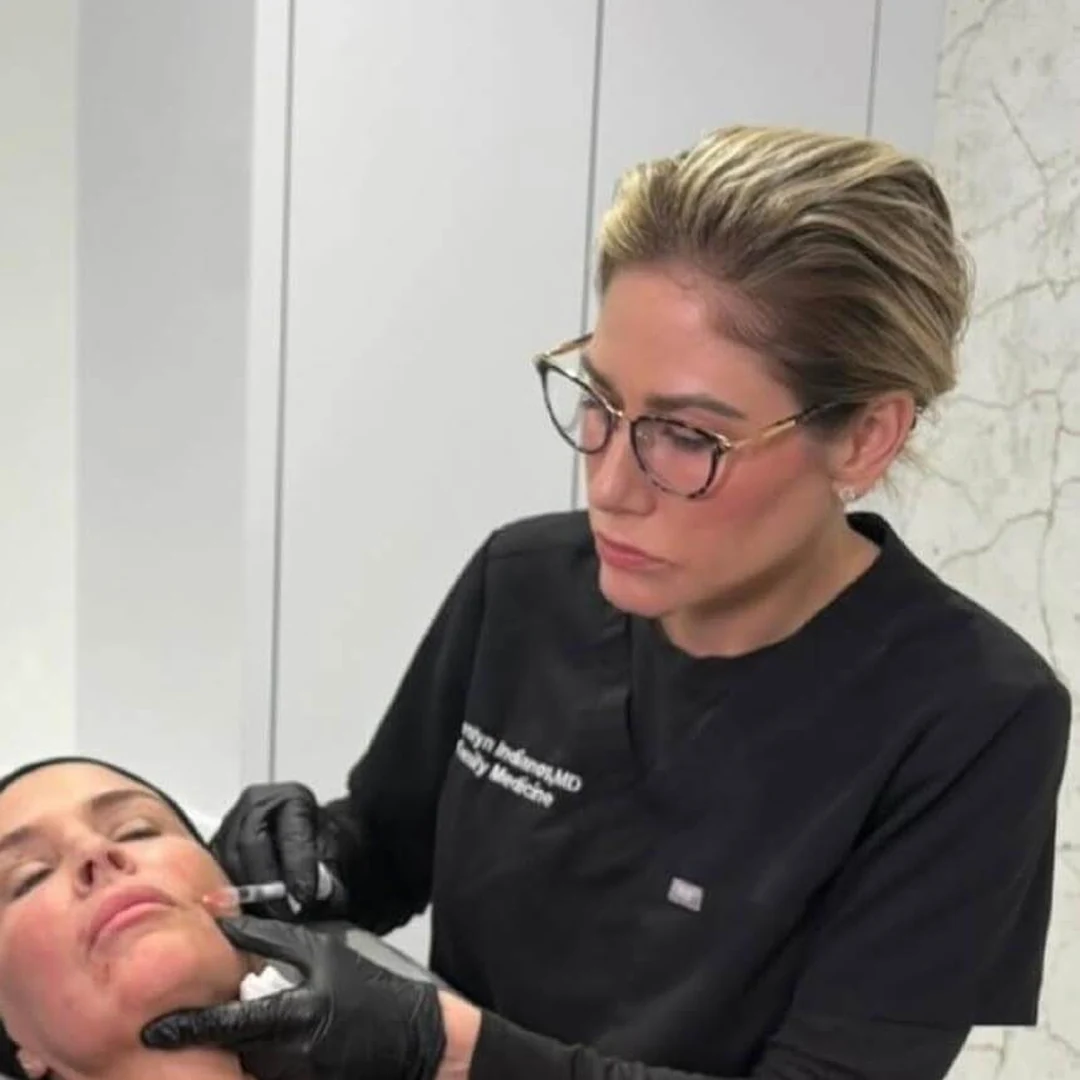
At Bespoke Aesthetics in Gainesville, you can book an evaluation with Dr. Carolyn Indianos, MD, to go over your history, your medication and weight-loss timeline, and whether lab work makes sense. If the picture points to something other than a temporary shed, she can discuss hair restoration options, including PRP and PRF, which are prepared from your own blood, and whether either is appropriate for you. See our hair restoration page and our PRP page for more. PRP and PRF are not FDA-approved treatments for hair loss, and whether either suits a given patient is a clinical decision Dr. Indianos makes after that evaluation. Patients managing weight with medical supervision can read how that works on our medical weight loss page.
Frequently asked questions
Does tirzepatide cause hair loss?
Hair loss is a reported side effect of tirzepatide (Zepbound, Mounjaro). In the Zepbound trials, 4% to 5% of adults reported it across the three doses, compared with 1% on placebo. It is most likely a temporary shedding pattern linked to rapid weight loss rather than direct damage to the follicle.
Is tirzepatide hair loss different from semaglutide hair loss?
The labels do not show a clear difference. Zepbound (tirzepatide) reports hair loss in 4% to 5% of adults versus 1% on placebo. Wegovy (semaglutide) reports 3% at the 2.4 mg dose versus 1% on placebo, and 5.8% at the 7.2 mg dose. Those figures come from separate trials in different patient groups, so they cannot be read as one drug being easier on hair than the other. Both labels tie hair loss to weight reduction, and both report it more often in women than in men. The same mechanism, rapid weight loss, is the likely driver for both molecules.
How much hair loss is normal on a GLP-1 medication?
Everyone sheds. The review literature puts normal daily shedding at roughly 100 to 150 resting hairs, which does not cause visible thinning. Weight-loss shedding (telogen effluvium) is usually diffuse and involves less than half of the scalp hair. In the Zepbound and Wegovy trials, about 3% to 6% of adults reported hair loss as an adverse reaction, depending on the drug and dose, so most did not. Shedding that is heavy, patchy, or still going after about six months is worth a physician evaluation.
How long does GLP-1 hair loss last?
In the telogen effluvium literature, shedding usually begins about two to three months after the trigger and is generally self-limiting, lasting around six months. Regrowth can be noticed 3 to 6 months after the trigger is removed, and cosmetically significant regrowth can take 12 to 18 months. Shedding that continues beyond roughly six months, or that appears as a patch or receding pattern, should be evaluated by a physician.
Is hair loss from weight loss permanent?
Telogen effluvium is generally self-limiting and does not destroy the follicle, so hair density typically recovers once the trigger settles. Recovery varies by person and cannot be guaranteed, and other causes of hair loss behave differently, which is why evaluation matters.
Will my hair fully grow back?
Telogen effluvium does not destroy the follicle, and the literature describes regrowth beginning 3 to 6 months after the trigger is removed, with cosmetically significant regrowth taking 12 to 18 months. No one can promise a specific result or date. Early pattern hair loss (androgenetic alopecia) can look like episodic shedding before its typical pattern appears, so some people find that a thinning tendency was there underneath. A physician can tell the two apart.
Should I stop my GLP-1 medication if my hair is shedding?
No, not on your own. Talk with the physician who prescribes it. They can review your dose, the pace of weight loss, your protein and calorie intake and your labs, and decide together with you what to adjust.
Which labs should I ask about for GLP-1 hair loss?
Published workups for diffuse shedding start with a complete blood count and ferritin (iron stores) and thyroid-stimulating hormone (TSH) and thyroxine (T4) levels. A zinc level is added when history or exam suggests it. Vitamin D deficiency may be associated with diffuse hair loss, so physicians often consider it as well, though it is not in that first-line list.
Can supplements fix GLP-1 hair loss?
The evidence is thin and the sources do not fully agree. One review states that vitamin supplements are not proven for hair loss and reports no effect of biotin, and it describes the evidence for iron replacement as limited, with some benefit in a few controlled studies. Another paper says biotin and zinc replacement can support hair regrowth. Both describe telogen effluvium as having no specific medical treatment. The common thread is to test first and replace only what labs show is low, with your physician setting the dose.
Medically reviewed by Dr. Carolyn Indianos, MD, Founder and Medical Director, Bespoke Aesthetics. Sources: FDA prescribing information for Zepbound, Mounjaro and Wegovy, and the peer-reviewed literature linked in this article. Last updated October 2026.
This article is educational and is not medical advice. To discuss hair shedding on a GLP-1 with a physician, call (352) 450-1004 or request a consultation with Dr. Carolyn Indianos, MD. You can also read about our physician-led GLP-1 weight loss program.
Zepbound and Mounjaro are trademarks of Eli Lilly and Company. Wegovy is a trademark of Novo Nordisk A/S. Bespoke Aesthetics is not affiliated with or endorsed by either company.